Haywood County Beekeepers Association 2026 Logo.

Haywood County Beekeepers Association

of the NC State Beekeepers Association

Swarms - Inspection and Prevention…

Swarms - Inspection and Prevention…

    Honey bees will attempt to swarm at some point in their lifecycle from any active, healthy, and thriving colony that becomes overcrowded. Beekeepers can count on this process occurring to preserve and ensure the survival of the species. It is an inherent biological trait of the bees to multiply, and this act of survival comes in the form of swarming.


    There are several reasons why bees leave a healthy colony, but in the end, it is time for the resident (parent) queen to relocate. In human terms we call it “leaving the nest” and in bee terminology this equates to the same thing. Honey bees will determine when it is time to leave and move to a new location. However, there are ways to prevent swarming if the beekeeper is diligent in their hive inspections.


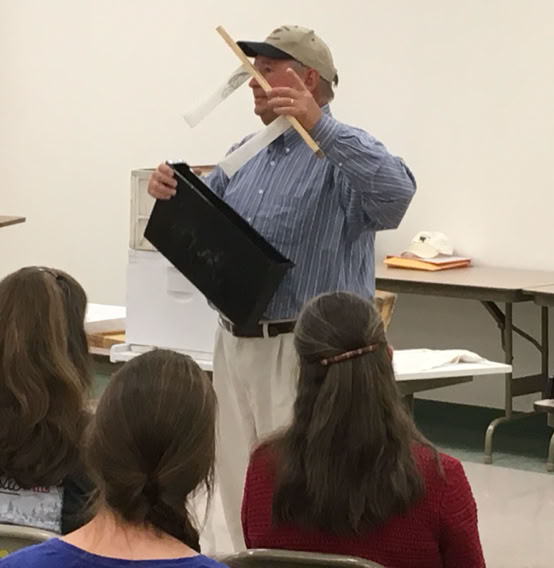
    The following notes (see below) were taken on April 4, 2017, during the monthly Haywood County Beekeepers Meeting. Tyree Kaiser, with forty-five years of beekeeping experience, made an excellent presentation on How to Prevent Honeybees from Swarming. These notes are not a complete representation of the entire program presented by Mr. Kaiser; however, they do reflect on techniques which will hopefully prevent bees swarming out of your established apiary.


      It became evident to this beekeeper that others could learn from Mr. Kaiser's demonstration, as he discussed the art of maintaining a healthy and vibrant beehive. His primary focus involved "splitting" over-crowed colonies and establishing a new hive that would expand the beekeeper’s apiary and allow them to keep what they have worked so hard to maintain, “honey!”


    Lastly, Mr. Kiser offered some sound advice about beekeeping to the members and visitors gathered that night, “Every time you attend a meeting or seminar about bees, always try to learn one new thing.” His words helped me to focus on this very act and in fact, I learn many new things about beekeeping during every meeting or seminar I attend. Try it! You will find that learning about bees is a never-ending and enjoyable task.


Zach,

HCBA webmaster

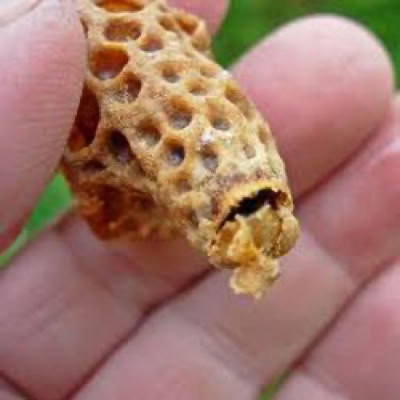
A hatch queen cell.

Hatched queen cell

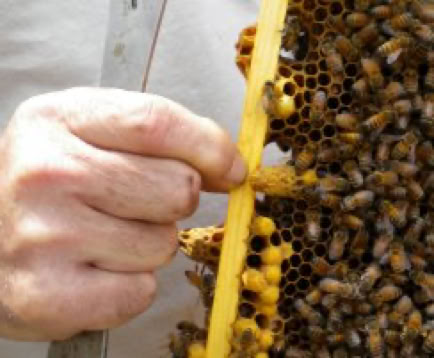
Beekeeper pointing to a queen cell under top bar of brood frame.

Queen cell on a frame

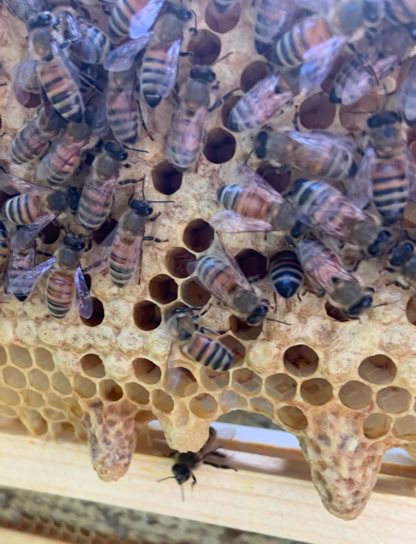
Swarm cells at bottom of brood frame.

Swarm cells on frame bottom

Swarm Control - Basic Management

Tyree Kiser discussing swarm prevention and making splits.

  • Young queens rarely swarm during the first year.
  • Good ventilation is essential. Thus, remove the entrance reducer for the strongest hives in April and gradually open the weaker hives as they get stronger.
    •   Note: A ¼ inch stick on back top of inner cover works well.
  • Add honey supers in the middle of April to reduce any crowding condition in the colony by using “drawn” comb, if possible.
  • Remove any “field force” bees by exchanging some stronger frames from one colony with a weaker colony. This should be done between the third week of April through May.
    •   CAUTION: Honey flow must be present so the bees will accept new hive.
  • Remove all brood frames and leave the queen with one frame of capped brood, honey, an empty “drawn comb,” and some “field force” bees then, make a split or division using a “double-screen” board between the hive bodies.
  • First week of April, place the brood and bees in the top hive body or super, OR reverse hive bodies and ensure the bees are in the bottom hive body.
    •    Reverse these hive bodies during the third or fourth week of April.
    •    Temperature needs to be in the 70’s, sunny, and with no wind to work bees in April.

Possible Prevention Method

    Swarming occurs when the “resident queen” and more than half of the established healthy bees are ready to relocate to a new hive. At this point, the natural tendency of a crowded colony is to expand and divide the colony by swarming (leaving the hive).  During this process, no surplus honey is produced and in fact, the bees that are ready to swarm will gorge themselves on honey that is need for the trip ahead.  Your task as “beekeepers” is to hopefully prevent this swarming action and instead, “split” the anxious hive and keep your bees in the apiary.

A family inspects a beehive wearing protective gear in a green field during summer.

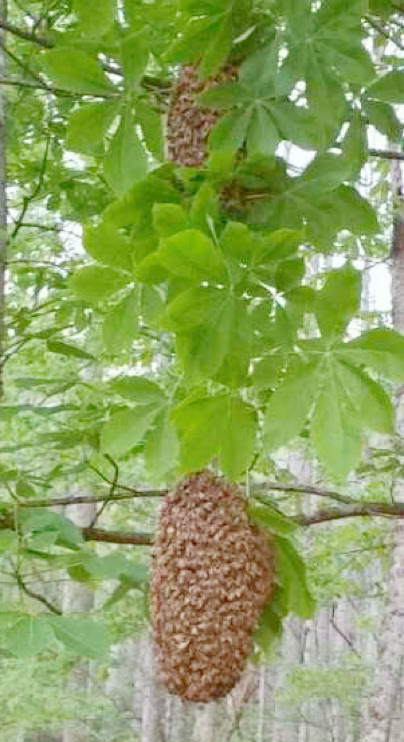
NOTE: It is vital that beekeepers monitor colonies for this natural action of swarming and be prepared to safely capture any swarm that may occur, especially from trees, etc.  Always have extra hive equipment ready for such an event.

  • BEFORE opening the colony- inspect for any signs of swarming and ensure that your hive equipment handy: hand tools, extra brood boxes, frames- a “frame-type” feeder (suggested) which requires the removal of two frames in the “new” brood box, smoker, hive tool, and a bee suit for protection.
    • After you “suit up,” tuck your trousers inside your boots or band them closely around the ankles. Use bee gloves to help protect against stings.
    • Leave the inner cover on and lift the top hive body or super body.
  • CHECK for any swarm (queen) cells- at the bottom of each frame because the natural tendency of the bees is to work upwards. Select a frame with multiple queen cells and remove it.
  • FIND the queen and place that frame in an empty brood box with a cover, so she will not be lost.
  • REMOVE one capped brood frame from the hive and place it in the new box. 
  • PLACE the queen on a frame in the brood box of the current hive, so the “field force” bees will return to the colony.
    • Colony should now contain the following: one frame of capped brood, the queen, one foundation frame of honey, pollen, and an empty drawn comb or foundation for expansion.
    • Add a super or hive body, then a “double-screen” spacer and another hive body with “brood bees,” containing one to three queen cells and a feeder. The “double-screen” spacer allows heat from “field force” hive to help keep brood warm.
    • Place some green grass in “double-screen” entrance to orientate the bees towards the new hive body.
  • Splitting the colony- you can perform a split and add a new queen, then wait one week before checking for any eggs. Ensure that all the queen cells are destroyed in the “split-hive.”
  • A producing queen- check the hive to see if the queen is producing and remember, it takes three to four weeks of forming to produce any bees from the queen cell.
  • Combining colonies- wait until the end of May, when the swarming season is usually over before you remove the “double-screen” spacer and combine the bodies into one hive.
    •    Now, you can move new hive as a split and use the “newspaper” method to unite the hives.
  • Observing colony action- note that bees with a “mean” disposition will run on the hive and the comb, while those with a “mild” disposition will typically stay in one local area of the comb and not fly out to sting you.
  • As a precaution- the time to swap hive boxes begins during the third or fourth week of April and continues until the end of May,
    •   Thus, swap hives during the middle of the day when a strong honey flow is present, so the bees will not fight, this process strengthens a weak colony.
    •    Equalizing the colony strength and the number of bees per colony helps to prevent (not eliminate) their tendency to swarm.


If you have questions about preventing swarms, you can contact Tyree at tkiser@charter.net, or visit with him at one of our monthly bee club meetings.

Haywood County Cooperative Extension

589 Raccoon Road

Waynesville, NC 28786

Mailing Address

Haywood County Beekeepers Association

P.O. Box 1391,  Clyde, NC 28721

Meetings

First Tuesday each month

Time:   7:00 PM

NC Cooperative Extension logo

©2017-2026 HCBA